


Who Cares?

Monday, June 22, 2026
Happy Monday, my friends! My experience and practice of faith have gone through cycles, emphasizing the stages and experiences of my life and what I needed in those moments. Perhaps the most distinct memory which sums up the time before I returned to full Christian identity was sitting in the meeting house of the Unitarian Universalist Fellowship of Burlington in Burlington, VT. In the next pew over from me sat a lovely woman in all red and a round black pointy hat—she was a witch with a penchant for English folk magic—in front of me sat two men who could never shake the military bearing which belied their flamboyant Queer identities. And there I sat still trying to make sense of what I was, what I believed, and how I could narrate my story of faith.
Last week’s Interfaith Pride Service was a good reminder that the question of tradition—which one, how much, and why it matters—is never purely abstract. When people from different faith backgrounds gather to worship and celebrate together, the boundaries between traditions become both more visible and, somehow, less important at the same time.
Long before my experiences in Burlington, I’ve been sitting with a version of that tension. It has only intensified as I’ve continued discerning my next steps in theological education. The question I keep returning to isn’t one anyone has asked me. It’s entirely internal: does my tradition matter, and if so, which one is mine?
On paper, the answer should be straightforward. I was formed as a cradle Catholic, received into The Episcopal Church, and am now ordained in The Fellowship of Affirming Ministries, a beautifully diverse body that includes clergy and congregations from more Protestant traditions than I can count on two hands. I’ve worshipped, studied, served, and led in more Christian traditions than most people encounter in a lifetime. If anything, that breadth should make the question easier. Instead, it makes it harder.
The honest answer is that I don’t feel strongly rooted in any single tradition. I find myself drawn to the liturgical richness of Roman Catholic and Episcopal (particularly Anglo-Catholic) worship while being equally drawn to the energy, spontaneity, and justice commitments of Pentecostal, Baptist, and broadly Reformed communities (particularly the United Church of Christ). My preaching sits at the intersection of several traditions at once. I am, theologically speaking, a person with many rooms and I’ve spent a fair amount of energy wondering how I can solve this problem. Because it is a problem, right? A pastor should know which tradition in which he stands.
But this question continues leading me back to another question: who cares?
I don’t mean that dismissively. I mean it as a genuine theological proposition. My tradition is Christianity, a faith so vast, so internally diverse, and so historically contentious that no single denomination or stream can claim to hold all of it. My tradition is also TFAM, a family and an organization that was founded precisely because many of the existing traditions had failed too many of God’s people. As a result, TFAM holds within it an extraordinary range of theologies, worship styles, and ecclesial backgrounds (check out the clergy procession during Holy Convocation for a wild and incredible example). In both cases, diversity isn’t an aberration. It’s a feature; a distinct and powerful goal.
There is real value in tradition. Traditions carry the wisdom, the wounds, and the hard-won insights of communities across time. They give us language, liturgy, and a sense of belonging to something larger than ourselves. I don’t want to lose that. More so still, I want to claim a part of tradition. But traditions can also become cages, particularly for people whose lives and identities have historically been excluded from or distorted by those same traditions. For LGBTQIA+ Christians, for BIPOC communities, for women and gender-nonconforming people, the demand to pick a lane and stay in it has often been a demand to accept the terms of communities that were never fully designed with us in mind.
Maybe the more honest question isn’t “which tradition is mine?” but “what do I actually believe, and where do I find communities that are living that out?” Traditions are containers. What matters most is what they’re holding and whether what they’re holding is life-giving.
What is your tradition? Does it still fit you, or have you outgrown it or has it outgrown you?
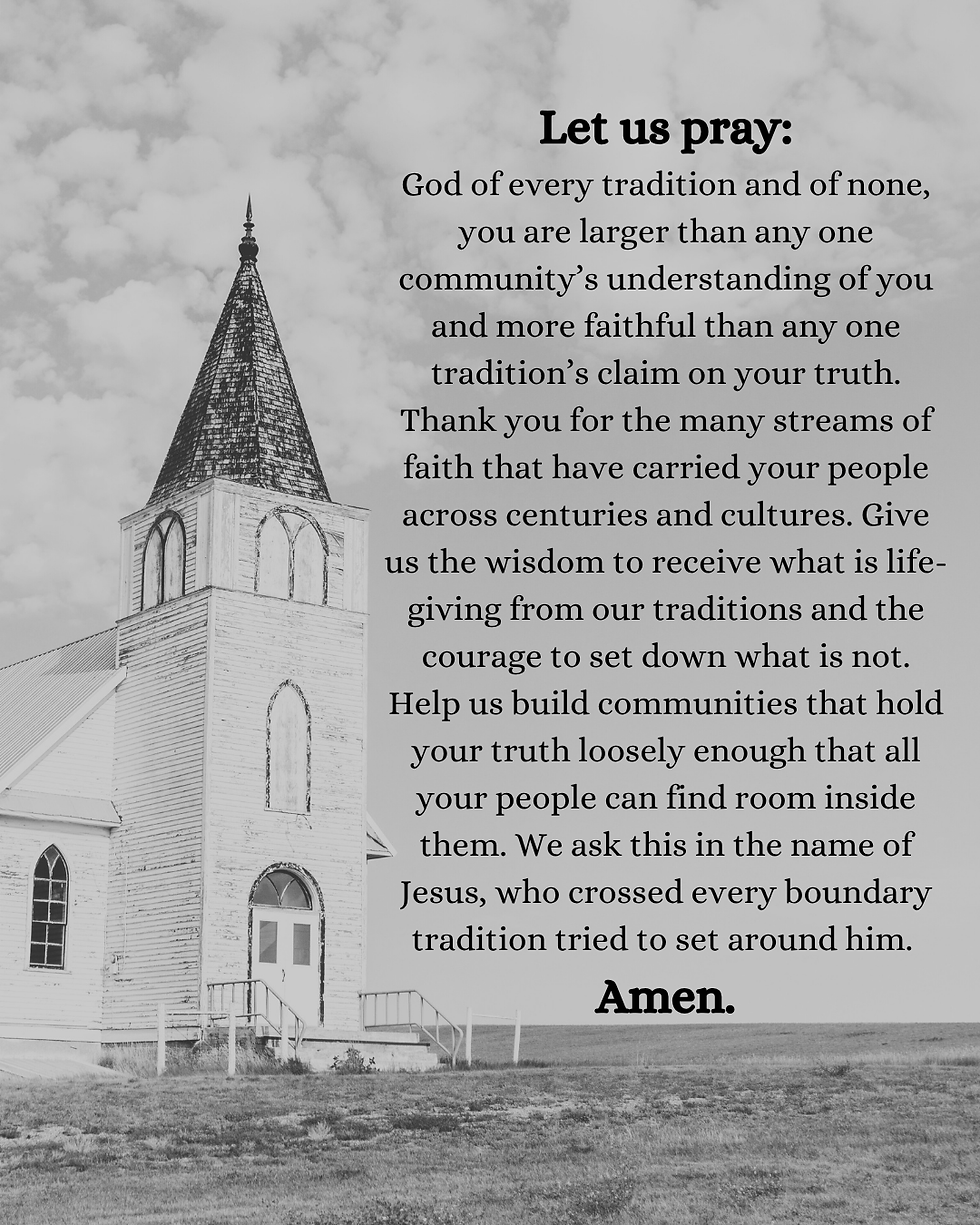
Let us pray: God of every tradition and of none, you are larger than any one community’s understanding of you and more faithful than any one tradition’s claim on your truth. Thank you for the many streams of faith that have carried your people across centuries and cultures. Give us the wisdom to receive what is life-giving from our traditions and the courage to set down what is not. Help us build communities that hold your truth loosely enough that all your people can find room inside them. We ask this in the name of Jesus, who crossed every boundary tradition tried to set around him. Amen.
Blessings on your weeks, my friends! Please let me know if there is anything I can do for you.
Faithfully,
Ben +


Healthy online communication (รับงานขอนแก่น) relationships begin with meaningful conversations and shared interests. Whether connecting through social media, messaging apps, or dating platforms, consistent communication helps establish trust and understanding. By respecting each other's boundaries and expressing thoughts honestly, people can develop rewarding relationships that extend beyond the virtual world.
amazing post. i often use instagram video download for learning videos.